Why Is Hajj Important?
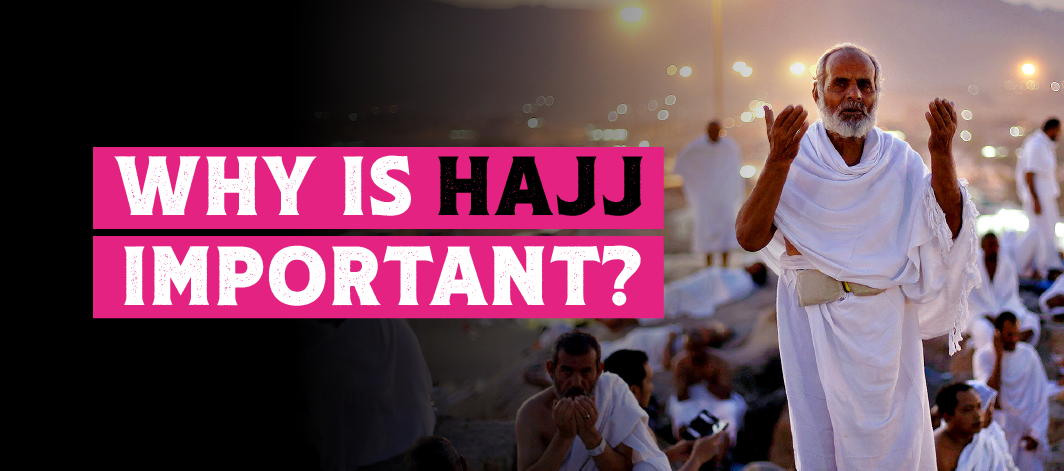
The annual Hajj pilgrimage to Makkah attracts millions of Muslims from all over the globe who congregate for a special, sacred event to worship Allah (SWT).
But whilst everyone knows it’s a special and sacred journey, not everyone knows precisely why Hajj is so important.
What is Hajj?
Hajj is the fifth pillar of Islam. It's a pilgrimage that occurs every year shortly after the start of Dhul Hijjah, the final month in the Islamic calendar. It’s a journey that every Muslim is expected to complete at least once in their lives if they are able to.
Every year at least 2 million Muslim pilgrims gather in Makkah for the five-day Hajj pilgrimage. Many of the Hajj rituals take place on the Day of Arafah (on Mount Arafat) and Eid al-Adha, the holiest days of the year in the Islamic faith.
Is Hajj Compulsory?
Any act that forms the five Pillars of Islam are seen as compulsory for all practicing Muslims. This includes Shahada (the belief in Allah SWT), Salat (prayer), Zakat (giving to charity), Sawm (fasting) and Hajj (pilgrimage to Makkah).
Unlike the other pillars, Hajj is the most physically demanding and time-consuming act. The physically taxing rituals take place over five days in the middle of a desert, and so are far from easy. More than that, since Muslims come from all over the world, it can be quite costly to book a flight all the way to Saudi Arabia.
But despite how physically exerting, time-consuming and expensive it can be, it’s still compulsory.
To help alleviate some of the financial difficulties, some charities and community leaders help other people make the journey. Some others save up their whole lives just to be able to perform Hajj once.
Why is Hajj the Most Important Pillar?
Like other pillars of Islam, Hajj is considered so sacred because it can strengthen your spirituality and connection to Allah (SWT). Its emphasis on the history of Islam can also help you better understand the religion, strengthening your relationship with Allah (SWT) even more.
Furthermore it is narrated by Abu Huraira that the Prophet Muhammad (PBUH) said:
مَنْ حَجَّ هَذَا الْبَيْتَ، فَلَمْ يَرْفُثْ، وَلَمْ يَفْسُقْ، رَجَعَ كَيَوْمِ وَلَدَتْهُ أُمُّهُ
Translation: "Whoever performs Hajj to this Ka`ba and does not approach his wife for sexual relations nor commit sins (while performing Hajj), he will come out as sinless as a newborn child, (just delivered by his mother)." - [Sahih al-Bukhari]
This highlights the importance of the pilgrimage to the holy city of Makkah, and all of the rituals that the Hajj pilgrimage entails. It is one of the best ways of purifying your soul and growing closer to our creator, Allah (SWT). The absolution that Allah offers to his pilgrims for their sins shows his supreme mercy, and desire for us to be pure and close to Him.
Hajj Strengthens Your Faith
If it were easy, it wouldn’t be much of a test, would it?
That’s partly why the Hajj pilgrimage is so physically demanding – it’s not meant to be easy. However, if you can push past that little voice in the back of your mind telling you to take it easy, you can prove your devotion to Allah (SWT). Even elderly Muslims refuse to give up, some hobbling along with a cane or crutches, insisting on walking and completing the Hajj to show their dedication.
But besides being a chance to show your love for Allah (SWT), the sacredness of the annual pilgrimage offers you the opportunity to wipe the slate clean; Allah (SWT) can forgive your past sins and you can start fresh with His blessings.
The spirituality of Hajj is only made stronger by the sacred state of Ihram. This relinquishes any hang-ups you might have about materialism or worldly pleasures. Instead the Ihram allows everyone to focus on their soul and inner self rather than what they look like on the outside, promoting Muslim unity within the Ummah.
It is mandatory that Muslim pilgrims enter the sacred state of Ihram before entering Makkah for their pilgrimage in order to attain spiritual purity. This is a religious state that insists you remain calm and avoid sexual activity, arguments, or violence of any sort.
Women forgo makeup or perfume, and instead wear simple, loose clothes with a head covering; men wear plain white clothes without any stitching, emphasising equality regardless of wealth.
Hajj Helps You Understand the History of Islam
Hajj takes Muslim pilgrims along the same route that the Prophet Muhammad (PBUH) walked hundreds of years ago, including the Mount of Arafat where he gave his final sermon.
The Trials of Prophet Ibrahim (AS) and His Family
Many of the sacred rites trace back to the Prophets Ibrahim and Ismail (AS). For example, Muslims slaughter livestock on Eid al-Adha to commemorate Ibrahim's test that he endured, when Allah commanded him to sacrifice his son Ismail (AS) before sparing him. The strength of the Prophet Ibrahim's faith in Allah is an example to all of us of how to lead a genuine and fulfilling Muslim life.
Pilgrims perform the Islamic tradition of Tawaf, in which muslims circle the Ka'aba seven times whilst reciting supplications (duas) to Allah. The Ka'aba is the most sacred site in Islam built by Ibrahim and Ismail as a house of monotheistic worship thousands of years ago. Observant muslims across the globe face the Ka'aba five times a day when they pray salah to the creator, such is the significance of this holy site.
In pre islamic times the Ka'aba was used to house pagan idols worshipped by ancient tribes from the Arabian peninsula.
Hajj also remembers Hajar (AS), Prophet Ibrahim’s wife, who ran between the hills of Safa and Marwa in search of water to help her dying son before Allah (SWT) provided a spring. People still make this journey today, running and walking between the two hills seven times, and visiting the spring, now known as the Zamzam Well.
When Muslims retrace the steps of our beloved prophets while performing Hajj, it helps us to understand the trials and tribulations they faced. Muslim pilgrims also wipe clean past sins as they engage in the monotheistic worship to our creator, Allah (SWT).
While Hajj is by no means as simple as the other four Pillars of Islam, it’s perhaps the most important and most sacred. This pilgrimage is compulsory for each Muslim to complete at least once in their life, and can help you better understand Islam and deepen your faith and connection with Allah (SWT).