Meals are where our work begins.
But they are not where it ends.
At Charity Right, we believe that serving food is only meaningful if it leads to real, lasting change in a child’s life. That is why we look beyond the number of meals served and focus on what those meals make possible.
This article explains how Charity Right measures impact, what we track, and why being honest about learning is just as important as reporting success.
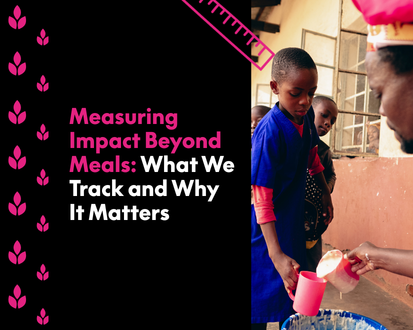
Why measuring impact matters
Hunger affects more than the body. It affects concentration, attendance, confidence, and the ability to learn.
If school meals are meant to support education and dignity, then measuring impact cannot stop at counting plates. It must help answer deeper questions.
Are children coming to school more regularly?
Are they staying in education longer?
Are they healthier and better able to learn?
Measuring these outcomes allows programmes to improve and ensures accountability to the children and communities we serve.
What we measure beyond meals
Across Charity Right programmes, impact is assessed using a combination of education and nutrition indicators. These help teams understand how consistent access to food is influencing children’s daily lives.
Education indicators
- School attendance, tracked daily where possible
- Enrolment and retention, showing whether children remain in education
- Exam pass rates and academic performance, where data is available
Across multiple programmes, schools supported by Charity Right regularly report attendance rates above 90%, with many achieving near full attendance. High exam pass rates further reflect the link between meals and learning.
Nutrition indicators
- Body Mass Index (BMI) tracked by age and gender
- Year-on-year comparisons to monitor healthy development
- Adjustments to meal composition as children grow and needs change
Nutrition data helps ensure meals support children not just today, but over time, particularly during key stages of growth.
Using data to improve, not to impress
Impact data is not collected to create headlines. It is used to make better decisions.
Monitoring allows teams to:
- Identify gaps in provision
- Adapt meal composition or delivery schedules
- Respond to seasonal or contextual challenges
- Learn where outcomes are improving and where further support is needed
In some cases, data highlights limitations. Baseline information may be incomplete. Sample sizes may be small. Contexts may change rapidly due to conflict or climate events.
We believe transparency includes acknowledging these realities.
Learning in complex environments
Charity Right operates in some of the most challenging contexts in the world. Displacement, food inflation, school closures, and insecurity all affect how programmes function.
Measuring impact in these environments is not always neat or linear. Progress may be uneven. Results may take time.
This is why impact measurement is treated as a learning process, not a final verdict. Programmes are refined as new information becomes available, and approaches evolve as conditions change.
What impact looks like in practice
When school meals are consistent and well-delivered, the effects compound.
Children attend school more regularly.
They remain enrolled longer.
They perform better academically.
Families experience reduced pressure.
Over time, education opens pathways to employment, independence, and leadership. These outcomes cannot be reduced to a single number, but they are visible in classrooms, households, and communities.
Why honesty strengthens trust
Impact reporting should build understanding, not overconfidence.
By sharing what we measure, how we measure it, and what we are still learning, Charity Right aims to offer a clear and credible picture of its work. This openness allows supporters, partners, and communities to assess progress realistically and hold us to account.
Doing charity right means being honest about outcomes, not just outputs.
Because behind every meal is a child whose future deserves care, attention, and truth.
Donate today to provide consistent school meals to children facing hunger.