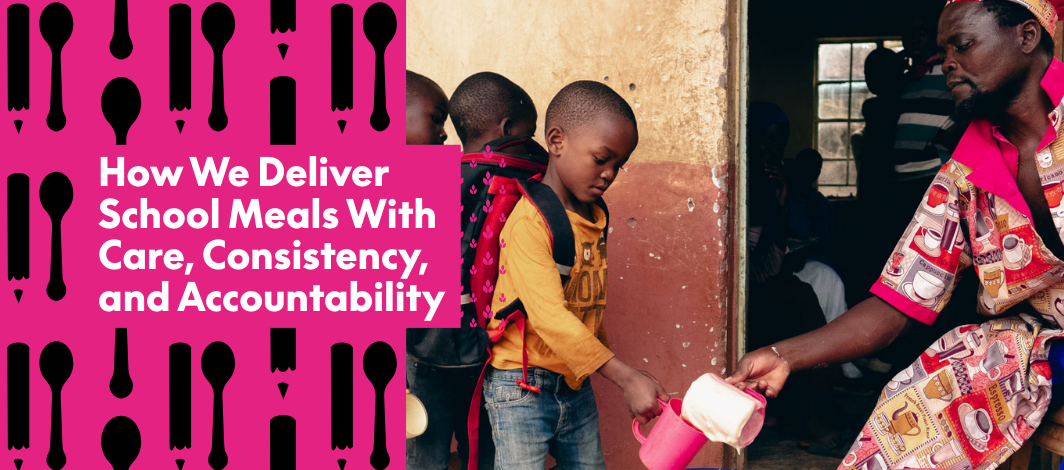
Providing a school meal is simple in principle. Doing it consistently, safely, and with dignity is not.
In the communities Charity Right serves, delivering a meal is rarely straightforward. Conflict, displacement, climate shocks, rising food costs, and fragile infrastructure all shape what is possible on the ground. That is why our work is built on systems, not one-off responses.
This article explains how Charity Right designs, delivers, and monitors its school meal programmes, and how we ensure accountability to the children, families, and communities we serve.
Starting with the right schools
Our programmes begin with careful school selection.
Charity Right works with trusted educational partners in communities facing the highest levels of need. Schools are chosen not only based on vulnerability, but also on their ability to provide a safe learning environment where children can benefit from consistent meals over time.
This approach ensures that food support strengthens education, rather than operating in isolation.
Building programmes that last
Meals do not happen on their own. Behind every plate is a system.
To deliver school meals consistently, Charity Right invests in:
- Local kitchens and food preparation facilities
- Trained staff and partner teams
- Sustainable supply chains adapted to local conditions
- Community engagement and ownership
These systems are designed to withstand disruption. Across our programmes, operations have continued through floods, conflict, extreme weather, and displacement by adapting delivery schedules, meal formats, and school calendars when needed.
Consistency matters, especially in uncertain environments.
Monitoring more than meals
Accountability is central to how Charity Right operates.
We do not measure success only by the number of meals served. Programmes are monitored using a set of key indicators that reflect both educational and nutritional outcomes.
These include:
- Daily school attendance
- Exam performance and pass rates
- Student enrolment and retention
- Nutritional indicators such as body mass index (BMI), tracked by age and gender
Monitoring allows teams to understand what is working, identify gaps, and adjust programmes over time. In some contexts, data also highlights limitations or areas for improvement, such as where meal composition needs to be refined to better support children as they grow.
We believe transparency includes being open about the areas we need to improve in.
Adapting to local realities
No two communities are the same, and neither are our programmes.
Country-level delivery is adapted to local conditions, whether in urban informal settlements, rural agricultural regions, refugee camps, or conflict-affected areas. Meals reflect local dietary culture, from fortified porridge in Malawi to rice and beans in Ethiopia, so children are served food that is familiar and acceptable.
Delivery also adjusts to circumstance. Meal schedules may shift during seasonal periods, school calendars may be extended to make up for closures, and food distributions may temporarily complement school meals during emergencies.
What remains consistent is the commitment to provide reliable meals that support children to stay in education wherever possible.
Safeguarding and governance
Protecting children is non-negotiable.
Charity Right operates under a governance structure that includes trustee oversight, regular board meetings, and continuous review of safeguarding policies. In recent years, safeguarding frameworks have been strengthened through audits, policy reviews, and tailored training for trustees, safeguarding leads, and staff.
These processes ensure that responsibility is shared, understood, and embedded across the organisation.
Using evidence to improve, not to impress
Data is a tool, not a trophy.
Attendance rates, exam results, and nutritional data are used to inform decisions, improve programme design, and allocate resources responsibly. Where data is limited, sample sizes are small, or baselines are still being established, this is acknowledged openly.
Our goal is not to present perfection, but progress.
Why transparency matters
Families trust us with their children. Donors trust us with their support. Communities trust us with their future.
That trust is earned through clarity, consistency, and accountability. By documenting how programmes operate and how impact is measured, Charity Right aims to ensure that our work can be understood, assessed, and improved over time.
We believe that doing charity right means being open about how we work, why we make decisions, and how we learn along the way.
Because when it comes to children, getting it right matters.
Donate today to provide consistent school meals to children facing hunger.