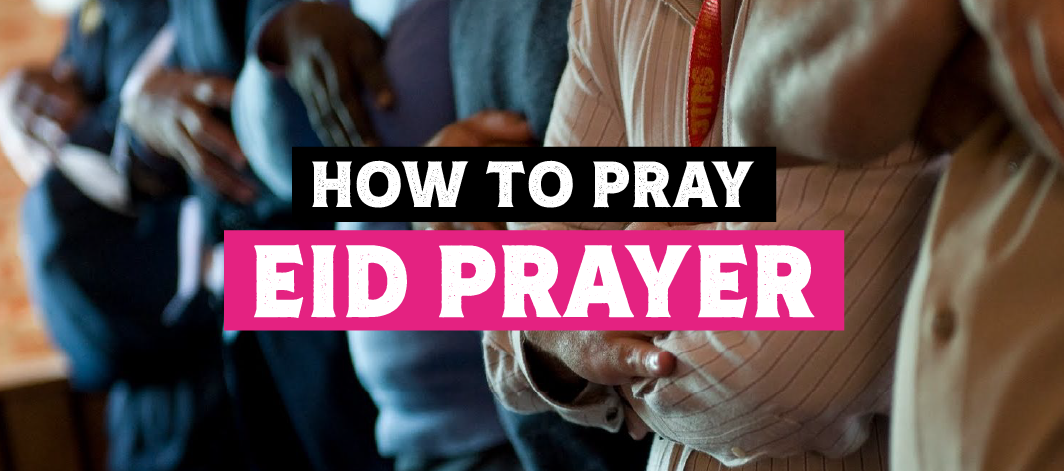
Eid celebrations are a joyous time and one of the highlights of the Islamic calendar, along with the prayers that go with them. However, since we only have Eid twice a year, we might need a little refresher to remind us of what to expect.
The Eid prayer is a momentous occasion that unites the Ummah in worship and celebration.
As the Imam recites this special prayer, we must listen intently whilst performing Eid salah and ensure that we make the correct recitations.
Follow our step-by-step guide for this special prayer to gain all the rewards and blessings that Allah (SWT) may grant us.
Is Eid Prayer Obligatory?
While the Eid prayer is not obligatory, the blessings and rewards you reap from attending make it highly worthwhile – and the fact that you’re following the example of the Prophet (PBUH) makes it even more meaningful.
This sunnah prayer is a great opportunity for us to connect with our brothers and sisters in the Islamic Ummah and share in the global celebration of Eid.
Do Eid Ul-Fitr and Eid Al-Adha Have the Same Salah?
The salah (prayer) performed on the day of Eid Ul-Fitr (or Eid Al-Fitr) and Eid Al-Adha are different in terms of the number of rak’at (units of prayer) and the takbeers (saying “Allahu Akbar”) performed during the prayer.
The Eid ul-Fitr prayer consists of 2 rak’at, and there are 6 additional takbirs during the prayer. The first takbir is performed at the beginning of the first rak’ah, and then five takbirs are performed before reciting the Qur’anic verses and completing the first rak’ah. In the second rak’ah, the Imam will start by reciting Qur’anic verses, and then perform five additional takbirs before completing the prayer with the usual Tashahhud and Salam.
On the other hand, the Eid Al-Adha prayer consists of two rak’at as well, but there are only two additional takbirs during the prayer. The first is performed at the beginning of the first rak’ah, during which the Imam recites Qur’anic verses. In the second rak’ah, the Imam will recite Quranic verses and perform one additional takbir before completing the prayer with the usual Tashahhud and Salam.
So, while there are similarities between the two prayers, they are not exactly the same. It’s important to note that the exact way of performing these prayers may differ slightly based on different Islamic schools of thought and regional practices.
When Should You Recite the Special Eid Takbeer?
In the previous section, we discuss reciting the regular takbir during the Eid prayers. There is, however, another unique takbir called takbeer at-tashreeq. It is widely agreed upon that reciting takbir at-tashreeq during the four days of Eid Al-Adha is sunnah.
It’s also sunnah to recite takbir at-tashreeq from sunset on the day before Eid Al-Fitr, until the Imam enters the mosque the next day for Eid prayers.
During the four days of Eid Al-Adha, this takbir should be recited after every fardh (obligatory) prayer, including the Eid prayer, from the Fajr prayer on the 9th of Dhul-Hijjah (the first day of Eid) until the Asr prayer on the 13th of Dhul-Hijjah.
How to Recite Takbir At-Tashreeq
During the four days of Eid Al-Adha, the takbir at-tashreeq is a common sound in many Muslim communities, with Muslims reciting it loudly in mosques, homes and public places. It is a way for us to celebrate the Eid festival and show our devotion to Allah.
The recitation of the takbir at-tashreeq is as follows:
اللَّهُ أَكْبَرُ اللَّهُ أَكْبَرُ لَا إلَهَ إلَّا اللَّهُ وَاَللَّهُ أَكْبَرُ اللَّهُ أَكْبَرُ وَلِلَّهِ الْحَمْدُ
Transliteration: “Allahu Akbar, Allahu Akbar, La ilaha illa Allah Wallahu Akbar, Allahu Akbar, wa lillahil Hamd”
Transliteration: “Allah is the greatest, Allah is the greatest, There is no God but Allah, And Allah is the greatest, Allah is the greatest and to Allah belongs all praise.”
There is also another variation of the takbir at-tashreeq in which people recite the takbir of “Allahu akbar” six times in total, instead of for. It can be said three times in the beginning and three times in the middle, instead of twice at the start and twice in the middle.
Please note that this special takbir, however, should not be recited during salah.
The Significance of Takbir At-Tashreeq
The takbir at-tashreeq is recited to commemorate the sacrifices made by Prophet Ibrahim (AS) and his family.
Allah (SWT) commanded Prophet Ibrahim (AS) to sacrifice his son Ismail (AS) as a test of his faith in Allah (SWT). As Prophet Ibrahim (AS) was about to sacrifice his son, Allah (SWT) replaced Ismail (AS) with a ram and accepted Prophet Ibrahim’s (AS) sacrifice as an act of obedience and submission. The takbir at-tashreeq is therefore a way for Muslims to honour this significant event and express gratitude to Allah (SWT).
What Time Is Eid Prayer?
Eid prayer starts after Fajr on the first day of Eid.
Muslims are encouraged to pray in congregation with their local community, meaning precise timings vary. We highly recommend that you check the schedule for your local mosque to make sure you’re not late!
Prepare for Eid Salah
While it’s sunnah to eat something sweet before Eid Al-Fitr prayers, it’s sunnah to eat something after Eid Al-Adha prayers – so make sure the cakes and bakes are ready!
When it comes to Eid Al-Fitr, you need to pay Fitrana before Eid prayers so that even the poor can be fed on that day. This only costs about £5 per person and is obligatory for every member of your household, including children and the elderly.
If you’re wondering, what is Fitrana? Don’t worry we’ve got you covered, just click this link.
How to Perform Eid Prayer
Make your Eid routine one to be proud of!
First, you should dress to impress. Make sure to wash and wear your best clothes. Remember – it is a celebration, so you could even buy some new clothes for this special occasion. As you begin walking to the mosque, say the takbir at-tareeq on your way to Eid prayer.
Now it’s time to perform the Eid salah. Like all prayers, you should start by making niyyah (intention) first.
First Rak’ah
• As you say “Allahu Akbar” (the opening takbir), men should raise their hands to their ears while women raise their hands to their shoulders.
• Next, recite the opening supplication:
Subhanak- Allahumma wa bihamdika, wa tabaarak-asmuka, wa ta-‘aala jadduka, wa la ilaaha ghayruk”
“O Allah, glory and praise are for You, and blessed is Your Name, and exalted is Your Majesty and there is no god but You.”
• This is followed by the Imam reciting multiple takbirs. For each one, you should raise your hands to either your ears or shoulders.
• Afterwards, listen to the Imam recite Surah al-Fatiha as well as another surah.
• The rest follows the same structure as a regular rak’ah.
Second Rak’ah
• The second rak’ah starts by listening to the Imam recite Surah Al-Fatihah again, followed by an additional Surah.
• Next comes three more takbir, during which you should raise your hands and let them fall to your side each time.
• After, go into a bowing position (Ruku’).
• The remainder of the prayer follows the structure of regular salah, ending with the recitation:
“assalamu alaikum wa rahmatullah”
Once the prayer has been concluded the Imam will likely give a khutbah (sermon) afterwards. The khutbah is extremely important as it will most likely convey the significance of Eid to you and your family members.
The Imam may also read certain passages from the Holy Qur’an in order to provide context for the Islamic tradition of celebrating Eid, so it is extremely important that you listen to the Imam intently.
Eid is an exciting time in the Islamic calendar, and it’s important to get the Eid prayer right to start it off in the best way possible.
Just remember to pay your Zakat if it’s due as well!
Want an easy way to get it done quickly? Donate here.